The YouTube Gap: Why Nigerian Banking’s Legacy Giants Are Losing the Video War

If you judged Nigeria’s five biggest banks by their social media followership alone, you would conclude they are digital titans. Between them, Zenith, GTBank, Access, UBA and First Bank command more than thirty million followers across X, Facebook and Instagram. That is a bigger population than most African countries.
But look closer and a strange contradiction emerges. The same institutions that have mastered the short text update and the carefully curated image are, with one notable exception, close to invisible on the platform that matters most for the future of customer trust: YouTube.
I spent the last week manually verifying the official handles of all five banks across four platforms, using only their native counters. No third-party trackers, no estimates. What the data reveals is not a ranking of popularity but a map of strategic priorities — and, in at least one case, of strategic neglect.
Understand the scenario.
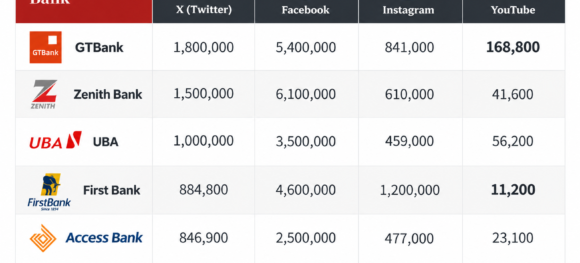
Look at First Bank, for instance. The bank, with 4.6 million followers on Facebook, 1.2 million on Instagram and 884,800 on X is one of the most followed financial institutions in the country looking at reach alone. However, First Bank has only . 11,200 subscribers. Read that again.
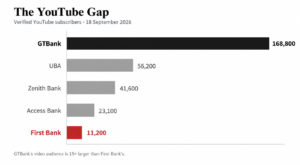
GTBank, by contrast, has 168,800 YouTube subscribers. UBA has 56,200. Zenith has 41,600. Even Access Bank, which trails First Bank on almost every other platform, has 23,100 — more than double First Bank’s audience.
What does this suggest? The maths does not lie. For a bank that has been in existence since 1894, and which has spent the last decade positioning itself as a digital-first institution, an audience of 11,200 on the second-largest search engine in the world is not a rounding error. It is a statement of priorities. First Bank owns the present of Nigerian banking social media. It does not appear to be building its future.
This is not simply a matter of vanity metrics. YouTube is not a place for corporate broadcasts to a captive audience. It is a search engine, a learning platform and — increasingly — the primary destination for young Nigerians looking for information, entertainment and, yes, financial education. The bank that wins on YouTube is not the one with the most followers. It is the one that understands content is not marketing collateral. It is the product.
GTBank has understood this for years.
If First Bank is the enigma, GTBank is the case study. Its lead on YouTube is not accidental. NdaniTV, its content arm, has been producing original programming for over a decade — long before Nigerian banks thought of themselves as media companies. Its X following of 1.8 million and its Instagram reach of 841,000 are strong, but they are downstream of a deeper competence: GTBank knows how to make things people want to watch.
This is not a small distinction. Most corporate YouTube channels in Nigeria are graveyards of press conferences, product launches and executive interviews that no one outside the company has any reason to watch. GTBank, by contrast, built an audience first and attached the brand second. It is the same logic that turned Red Bull into a media house that happens to sell energy drinks, and it is the same logic Nigerian banks continue to ignore at their peril.
Zenith has built a Facebook fortress.
If GTBank is the media house, Zenith is the mass-market institution. Its 6.1 million Facebook followers make it the largest bank page in the country by some margin. The bank’s 610,000 and 1.5 million followers on Instagram and 1.5 million and X, respectively, look solid and respectable. However, its YouTube audience of 41,600 suggests the bank is still largely in broadcast mode, at least in comparison to GTBank: able to reach many but not yet building the trust-deepening engagement that video allows.
Could this be a deliberate strategy? Maybe. Zenith’s brand promise is stability, safety and scale. Facebook, for all its cultural decline among the urban elite, remains the most reliable platform for reaching the Nigerian mass market. But it is worth asking how long that logic holds. The next generation of banking customers is not on Facebook. These folks are on YouTube and TikTok, and I am willing to bet that for this demographic, corporate reassurances mean little. Most of the time, these folks are just looking for answers and expression.
The quiet middle: UBA and Access.
UBA has built the most balanced portfolio of the five, with strong numbers on every platform and a YouTube audience of 56,200 — second only to GTBank’s. Its X following of 1 million is respectable, and its Facebook reach of 3.5 million places it comfortably in the top tier. Access Bank, meanwhile, has the smallest overall digital footprint of the five: 23,100 YouTube subscribers, 2.5 million on Facebook and 846,900 on X.
Would it help if both banks look at GTBank’s YouTube numbers and ask themselves a hard question? Probably. For a financial services brand to build an audience of 168,000 subscribers, we have to accept that is went out to do this by treating video as a product. That approach contrasts with the others who have treated video as another channel for press releases, mostly posting event recordings.
The lesson is simple, and uncomfortable.
Reach is not the same thing as relevance. A bank can have 4.6 million Facebook followers and still be invisible to the audience that will decide its future. A bank can have 1.2 million Instagram followers and still fail to teach a single young Nigerian how to save, invest, or avoid a scam. This is the central failure of digital strategy in Nigerian banking. The institutions have confused distribution with engagement, and volume with trust.
The Nigerian banking sector has spent the last decade mastering the art of the short update: the tweet, the caption, the carefully curated image. What it has not done, with one exception, is commit to the harder, slower work of producing video content that people actually want to watch. That is the gap the data exposes. It is also the opportunity.
I know this industry. I worked inside it at Zenith Bank, and I have watched from the outside as it has invested heavily in digital transformation in almost every area except the one that matters most to how customers actually perceive them. The bank that closes this gap will not simply have more subscribers. It will have more trust. It looks to me like this is important as customer loyalty is now being shaped and defined by digital experience. From what we see, that touchpoint is becoming the most important, which is why trust is the only currency that matters.
Methodology note: All figures were manually verified via native platform counters on 18 September 2026. No third-party trackers or estimates were used.